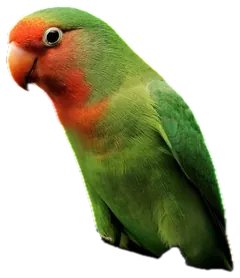
 Lovebirds
What can a lovebird eat?
20 foods checked against vets’ sources: what’s fine, what only now and then, and what never.
Every day
Small-parrot pellets always available as the base (about three quarters of the diet) plus a few seeds every day: on pellets alone they can get kidney problems. The rest fresh fruit and vegetables, no more than a quarter. Never avocado, chocolate, caffeine, alcohol or salty food.
No food matches: if it isn’t on the list, ask your vet before giving it.
Never
AlcoholNo
It's toxic to birds, even in small amounts.
Source: Association of Avian Veterinarians: Basic care for companion birds
AvocadoNo
It's poisonous to cage birds (budgies, canaries, cockatiels): it damages the heart and can kill.
Source: Association of Avian Veterinarians: Basic care for companion birds
ChocolateNo
It's toxic to birds: never.
Source: Association of Avian Veterinarians: Basic care for companion birds
Coffee, tea and caffeinated drinksNo
Caffeine is toxic to birds.
Source: Association of Avian Veterinarians: Basic care for companion birds
Crisps, salty snacks and sweetsNo
Very salty foods are toxic to birds, and junk food (salt and sweets) should be avoided.
Source: Association of Avian Veterinarians: Basic care for companion birds
Fruit seeds and pitsNo
Always remove seeds and pits before offering fruit.
Source: University of Florida College of Veterinary Medicine: How to care for your pet bird
Milk and cheeseNo
Dairy products are among the foods not to give birds.
Source: Merck Veterinary Manual: Nutritional diseases of pet birds
OnionNo
It's among the foods not to give birds.
Source: Merck Veterinary Manual: Nutritional diseases of pet birds
Only now and then, a little
Seed mixA little
Lovebirds need a few seeds every day: avian vets say small parrots fed only pellets can develop kidney problems. But seeds are fatty: keep them a small part of the diet.
How much: A little every day, at most a tenth of the diet; the rest pellets, vegetables and some fruit.
Source: Association of Avian Veterinarians: Basic care for companion birds
Sunflower seeds and peanutsA little
They're very fatty and low in calcium; badly stored peanuts can carry toxic moulds (aflatoxins). Treats only.
How much: Very few, as a treat or training reward.
Source: Merck Veterinary Manual: Nutritional diseases of pet birds
Fine
Apple (without seeds)Yes
Fine in small pieces, but without the seeds: apple seeds are among the foods to avoid.
How much: Small pieces every day; fruit and veg together at most about a quarter of what the bird eats.
Berries (blueberries, strawberries, raspberries)Yes
Fine; but be careful with wild berries, as some are poisonous.
How much: Small pieces every day; fruit and veg together at most about a quarter of what the bird eats.
Bird pelletsYes
They're the easiest way to give a complete diet: every piece has vitamins and minerals, and the bird can't pick out only the fattiest seeds.
How much: The largest part of the diet: about three-quarters for parrots (RSPCA); the RVC says 80% for budgies and 60-80% for cockatiels.
Source: Association of Avian Veterinarians: Basic care for companion birds
Broccoli, spinach and kaleYes
They're among the vegetables vets recommend for budgies and cockatiels.
How much: Small pieces every day; fruit and veg together at most about a quarter of what the bird eats.
Source: Royal Veterinary College: Cockatiel care and advice (2022)
CarrotYes
It's one of the recommended vegetables, washed well.
How much: Small pieces every day; fruit and veg together at most about a quarter of what the bird eats.
Dandelion and wild greensYes
Washed dandelion leaves and other wild greens make good fresh food, especially for canaries.
How much: A little every day, picked away from roads and treated lawns, and washed well.
GrapesYes
Unlike for dogs, grapes are among the recommended fruits for birds.
How much: Small pieces every day; fruit and veg together at most about a quarter of what the bird eats.
Oranges and tangerinesYes
They're on the University of Florida's list of fruits for parrots.
How much: Small pieces every day; fruit and veg together at most about a quarter of what the bird eats.
Source: University of Florida College of Veterinary Medicine: How to care for your pet bird
PeasYes
They're among the recommended vegetables.
How much: Small pieces every day; fruit and veg together at most about a quarter of what the bird eats.
PepperYes
Fine: according to the University of Florida, even hot peppers.
How much: Small pieces every day; fruit and veg together at most about a quarter of what the bird eats.
Source: University of Florida College of Veterinary Medicine: How to care for your pet bird
When to call the vet Emergency: who to call
What other pets can eat
Rabbit Guinea pig Hamster Pet rat Ferret Canary Budgies Cockatiel Tortoise Red-eared slider Leopard gecko Bearded dragon Goldfish Betta fish Dogs and cats: can my pet eat it?
Sources
- Association of Avian Veterinarians: Basic care for companion birds (checked on October 14, 2026)
- Merck Veterinary Manual: Nutritional diseases of pet birds (checked on October 14, 2026)
- RSPCA: What to feed your pet bird (checked on October 14, 2026)
- Royal Veterinary College: Cockatiel care and advice (2022) (checked on October 14, 2026)
- University of Florida College of Veterinary Medicine: How to care for your pet bird (checked on October 14, 2026)