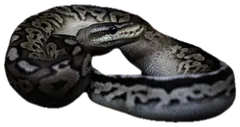
Ball python: lifespan, size, diet and care
It can skip meals for weeks, especially in winter: if its weight stays stable, that’s usually normal.
In Italy only captive-bred pythons can be kept, not wild-caught ones (Legislative Decree 135/2022). The ball python is in Annex B of the EU wildlife trade rules (CITES): no certificate is needed, but keep proof of legal purchase, such as the invoice. In Italy, babies born at home must be reported within 10 days to the Carabinieri CITES units.
Take the quiz: is it right for you?
How big it is
An adult is up to 183 cm (72 in) long.
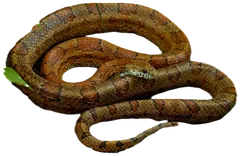
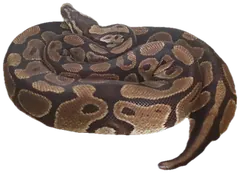
Snakes are measured in length: the orange bar is their true length, next to the man. The photos (coiled) aren’t to scale.
Before it arrives
- A vivarium at least as long as the snake and at least a third of its length wide and high (for 120 cm: 120 × 40 × 40 cm, about 48 × 16 × 16 in), securely closed
- A guarded heat lamp with a thermostat (basking 30–32 °C / 86–90 °F, cool end 24–26 °C / 75–79 °F), two thermometers and a heater with no light for the night
- Several hides at both ends, snug when it's coiled, and a humid one with damp moss
- A water bowl big enough to soak in
- Reptile soil or paper; no sand, cedar, wood shavings, corncob or gravel
- Frozen prey and tongs to offer it; never live prey
- Run the vivarium for a week first; after it arrives, leave it alone for 1 to 2 weeks
Its home: temperature and light
- Basking spot
- 30–32 °C (86–90 °F)
- Cool side
- 24–26 °C (75–79 °F)
- At night
- 24–26 °C (75–79 °F)
- Humidity
- 50–80%
- Light
- 12 hours a day
- UVB lamp
- helpful, not required
What it eats and how often
thawed frozen prey, every 7–14 days as an adult
- Babies: every 5–6 days
- Juveniles, up to 2-3 years: every 7–10 days
- Adults: every 7–14 days
One frozen-thawed prey item (mice or rats) per meal, about as wide as the widest part of its body: the RSPCA says slightly wider, ARAV says no wider. Never live prey. Offer it with tongs and don't handle the snake for 48 hours after a meal, or it may bring it up.
Vaccines and checkups
None: reptiles don't need vaccines.
A checkup at the vet every year. With a reptile vet.
The care calendar
What to do, from the most frequent to the least.
- every dayCheck the temperaturesWith two digital thermometers, one at the warm spot and one at the cool end: thermostats can be off.
- every 10 daysFrozen-thawed preyPrey about as wide as the widest part of its body. Young snakes eat every 5–6 days, adults every 7–14.
- every monthFull clean of the terrariumRemove droppings as you see them; fresh water every day.
- every yearYearly check-upWith a reptile vet.
Call the vet right away if…
If you see one of these signs, call your vet now: don’t wait for it to pass.
- Breathes with its mouth open, wheezes, or has bubbles or mucus at the nose or mouth
- Old skin left over the eyes or in rings after a shed, especially on the tail tip
- Refuses food and loses weight, or brings up its meals
- Holds its head twisted upward, trembles, or can't turn over when on its back
- Tiny black specks on its body or around the water bowl, or it soaks for hours
Frequently asked questions
How long does a ball python live?
Usually 20–30 years.
How big is a ball python?
An adult is up to 183 cm (72 in) long.
How much does a ball python weigh?
We have no adult weight for this pet from a vet source: what matters is that its weight stays steady.
What does a ball python eat, and how often?
Thawed frozen prey, every 7–14 days as an adult. One frozen-thawed prey item (mice or rats) per meal, about as wide as the widest part of its body: the RSPCA says slightly wider, ARAV says no wider. Never live prey. Offer it with tongs and don't handle the snake for 48 hours after a meal, or it may bring it up. Babies: every 5–6 days; juveniles, up to 2-3 years: every 7–10 days; adults: every 7–14 days.
Does a ball python need vaccines?
None: reptiles don't need vaccines.
When should a ball python see a vet right away?
Right away if you see one of these signs: breathes with its mouth open, wheezes, or has bubbles or mucus at the nose or mouth; old skin left over the eyes or in rings after a shed, especially on the tail tip; refuses food and loses weight, or brings up its meals. The others are above, in “Call the vet right away if…”.
How old is a ball python in human years?
There’s no serious human-years chart for a ball python: the ones online don’t cite sources. What counts is where it is in its life: its senior years start at about 15 to 22.5 years old.
Tools for your ball python
Always ask your vet: this site helps you understand, it doesn’t replace a checkup.
Sources
- RSPCA, Royal python care (checked on September 30, 2026)
- Merck Veterinary Manual, Table: Important Husbandry Requirements for Selected Reptiles (checked on September 30, 2026)
- Italian Ministry of the Environment (MASE), CITES note of 4 March 2026, and Regulation (EU) 2026/1383 (checked on October 13, 2026)
- Italian Legislative Decree 135 of 5 August 2022, art. 3 (wild-caught exotic animals) (checked on October 13, 2026)
- Association of Reptile and Amphibian Veterinarians (ARAV), Ball Pythons, Companion Reptile Care Series (PDF, copy on a veterinary clinic website) (checked on October 13, 2026)
- Merck Veterinary Manual, Routine Health Care of Reptiles (checked on October 14, 2026)
- Merck Veterinary Manual, Viral Diseases of Reptiles (checked on October 14, 2026)
- Merck Veterinary Manual, Disorders and Diseases of Reptiles (checked on October 14, 2026)
- RSPCA, Corn snake care (checked on October 13, 2026)
- Animal Diversity Web, Python regius (checked on October 13, 2026)